Past
Even before my time at the university, I expressed great interest in design and innovation. I was intrigued by the possibilities it brought to our society and everyday life. I joined the Bachelor program to channel my creativity and learn to recognize design opportunities in the world around me. Where I spent my time in the Bachelor’s program broadening myself and discovering my strengths, weaknesses, and interests. I spent my time in my Master’s to deepen myself and become skilled in the User & Society and Creativity & Aesthetics expertise area.
Present
Over the time of my Master I have developed into a critical designer with an interest in psychology and healthcare. When ether it’s through working with blind children, elderly with dementia, or adults with COPD, each project again and again showed me how empowering design can be and sparked my passion for social design. In my work, I aim to empower and socially integrate people who are affected by (mental) health issues and as a result restricted to participate in everyday life. I want to enable people to be their ‘best self’ in society.
Therefore, during this Master study I started my journey towards “my best self” as a professional design researcher. A journey without ending, since there is always something new to learn.
Over the years I have developed myself in the different expertise area’s that are used within the department. I also formed my own interpretation of what these area’s mean to me and how I value them in my design approach.
Read more about this below:
User and Society
I see my development in the expertise area of User & Society as my ability to empathize with my target user, sharing perspectives, researching situatedness, and shifting between the level of the individual and the collective. All and all: understanding through (inter)acting
To be able to translate my vision ‘use design to enable people with special needs to take back control over their own QoL’ by enhancing their daily empowerment and social integration, I must be able to emphasize with my user. This in order to identify the core of their problems or needs. To do this I believe it is important to involve my users as much as possible and thus follow a user-centered design process. Over the years I have used multiple different UX (research) methods in practice and was able to build my own UX research ‘toolkit’.
Through projects and courses I have gained a lot of experience and knowledge around user-centered data collection both in lab and field settings (the last one having my preference). During these studies, I used various inspirational and evaluative methodologies such as interviews, user observations (with the design probe/in context), user tests (both product and interaction- level), focus group sessions, co-evaluation sessions, and even tactile material exploration studies with my users.
Stakeholder involvement also thought me the importance of being able to position design in a historical, societal, and cultural context. An example of this is how during a data tracking project a participant did not want to wear the dedicated smartwatch I brought for her. As she thought it to be a man’s watch instead of a woman’s.
As design truly shapes the future I find it important to keep the societal or cultural trends it can provoke in the back of my mind.
In addition to the courses at the department of ID I have also followed extracurricular courses at the department of ‘Human technology interaction’ (HTI) and philosophy courses that are an initiative of the Philosophy and Ethics of Technology section of Eindhoven University of Technology. I did this to learn more about psychology and human behavior, as well as learning to ask the right questions while designing. ‘Why?’ and also ‘How?’ are namely questions that constantly pop up in my curious mind. Understanding the workings of the human brain through courses such as ‘Advanced Cognition’ and ‘Design for behavioral change’ allowed me to quicker understand what features of a design probe trigger certain behavior in my users. While the philosophy courses kept me checking in with myself how ethical these behavior manipulations I can cause are, and can be.
Courses that contributed to my development:
- Behavorial & social theories of Human-technology interaction
- Cultural Sensitivity
- User Experience Design
- Constructive Design Research
- Design for behavioral change
- Advanced Cognition
- Design for Social Innovation
- Use: History & Ethics
- Ethics of technology
- Philosophy of science and technology

Creativity and Aesthetics
For me Creativity & Aesthetics goes far beyond the ability to work through creative blocks with the usage of appropriate design methods. It is about realizing there is strength and meaning in shapes and colors. Form and material (textures) contribute to the user experience. Aesthetics does not (only) refer to how beautiful something is, but also how the aesthetics and the aesthetics of interaction align with the intended experience. Therefore in my work I am always asking myself “What should it trigger in people?”
As stated in my professional Identity I believe my strengths lie in Ideation and thinking out of the box is something I love to do. Learning about a large variety of methods and techniques that can be used for idea generation and -selection gave me the tools to structure my creativity and communicate generated ideas. I also realized that delivering multi-stakeholder value from a multi-disciplinary angle, requires a creative process where I shift between a first, second and third perspective and continuously reflect on my actions in between.
I learned that the aesthetics of the design probe I put in front of my clients matters greatly. Where when presenting polished and professional looking visuals to my client I was taken more seriously. However when presenting a polished prototype in a user test.. the useful critical feedback often stayed out. (Depending on the purpose of the test) showing users half-finished prototypes turned out to be optimal for participatory ideation. Participants were no longer scared to be critical of the design but actively thought along about the eventual look and functions of the design. Sharing opinions on shape interpretations, and material experiences.
The aesthetics can have a large influence on the usability of a product, an example of this is my project ‘Family Window’ where warm technology is used to let users with dementia gain trust in the device. Through aesthetics a designer communicates with their user, giving feedback and feedforward. In traditional product design, aesthetics were only considered to be the appearance of the product. Products were designed to look beautiful. However now products are becoming more interactive, I think it is important in my work to also take the aesthetics of the interaction with the user into consideration.
Courses that contributed to my development:
- Tangible and Embodied Interaction
- Aesthetics of Interaction
- A designerly perspective on IoT; a growing systems approach
- User Experience Design
- Design for Social Innovation
- The Sound of Smart Things
- Researching the Future Everyday

Technology and realization
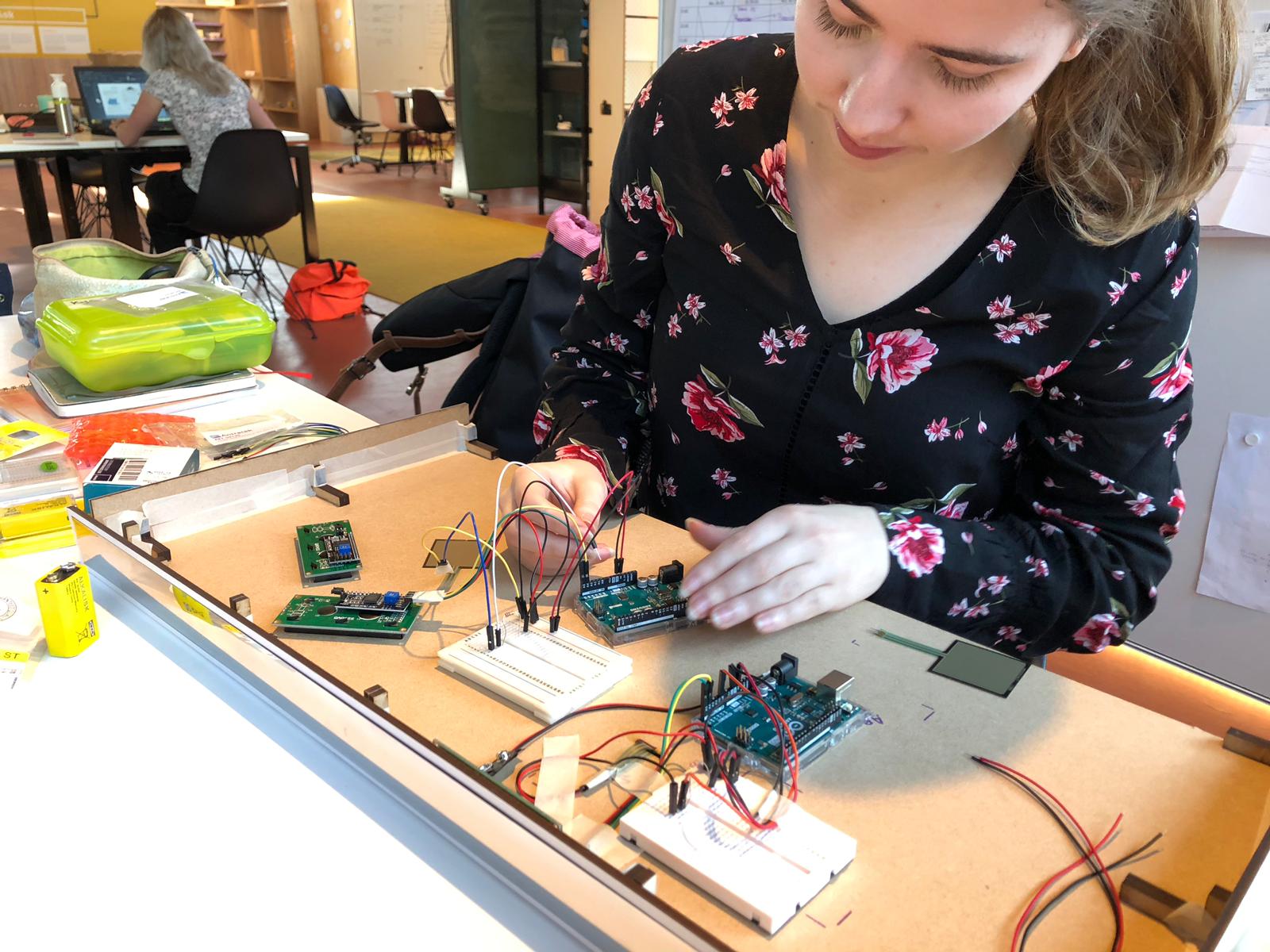
In my work I see the role of Technology & Realization as the ability to know what is technically feasible and to understand what role technology can play in dealing with design challenges. But also having sufficient knowledge (or knowing where to maintain sufficient knowledge) to communicate with experts, or be able to communicate through a demonstrator the essence and value of my design concept to a user/client.
This makes T&R an important expertise area that allows for the exploring, visualizing, creating, and demonstrating of my ideas. Although it is not my strong suit nor my main point of interest, I developed myself in this expertise area to help me better communicate my ideas with others and explore how users experience and react to the technology.
I have always been fascinated by user-product interactions. Especially through tangible design probes, because of the value it can bring for special need groups. It is enthralling to see how a person with dementia reacts to different tactile stimuli (Pettow), how tactile sensations can provide an immersive experience (Bonding in the Artificial Womb), or how it can support non-visual bonding processes (Miause). These prototypes enabled tangible thinking and was the foundation of very interesting conversations in multi-stakeholder settings.
However since almost the entirety of my Master’s happened from my room behind a screen (due to Covid) I was forced to also explore digital prototyping besides my love for the tangible. I suddenly worked often with application building software and created video prototypes, manipulating sounds and 3D models to give the illusion of a working prototype.
I created a solid base skillset for the creation of interactive (tangible) prototypes through my development in basic programming competencies, simple electronic circuits, and my usage of different app building software, sound manipulation, and AR tools such as Adobe Aero.
Especially during interdisciplinary projects where I worked together with engineers from other disciplines I learned, in contradiction to my previous beliefs, that I do not have to be an astonishing programmer to be a useful addition to the team. My base of experience with programming allows me to think like professional programmers, and this allows me to communicate with them during a project while they go into the depth of the code. This ability for communication makes it that I can deliver good (technically working and also user-oriented so it fits in the context) design during final presentations, understand the financial budgeting of prototypes, and participate in hardware selection.
Courses that contributed to my development:
- Aesthetics of Interaction
- Engineering Design
- The Sound of Smart Things
- A designerly perspective on IoT; a growing systems approach
Business and Entrepreneurship
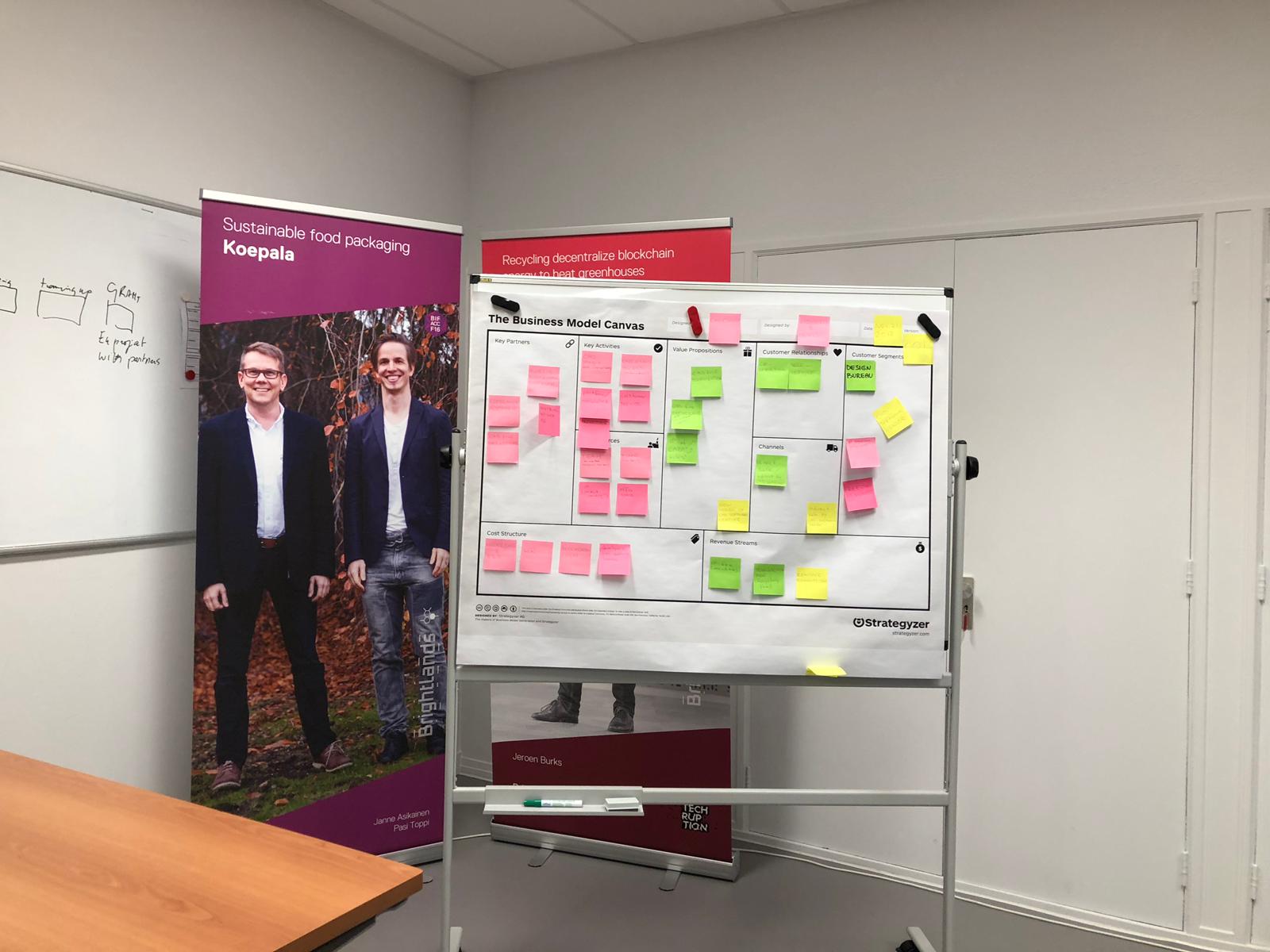
For me the Business & Entrepreneurship expertise area is about understanding value exchanges, exuding leadership capabilities, and stakeholder management. It encompasses managing multi-stakeholder processes to create valuable human-centered innovation, with an understanding of how to identify and tackle challenges both on an abstract and concrete level.
Especially these past years in lockdown made communication with clients often difficult due to a lack of physical presence and reliability. Through this experience I learned what I can, and what I cannot expect from different stakeholders as well as the importance of a proactive work ethic. Where in the past I could be confused over the lack of interest a client was displaying in the work that was also being done for their benefit, I quickly realized they were not just going to come to me. I will need strong arguments, clear stories, and professional visuals every step of the way to be taken seriously. And should not be scared to communicate clear expectations, as transparency turned out to be greatly valued.
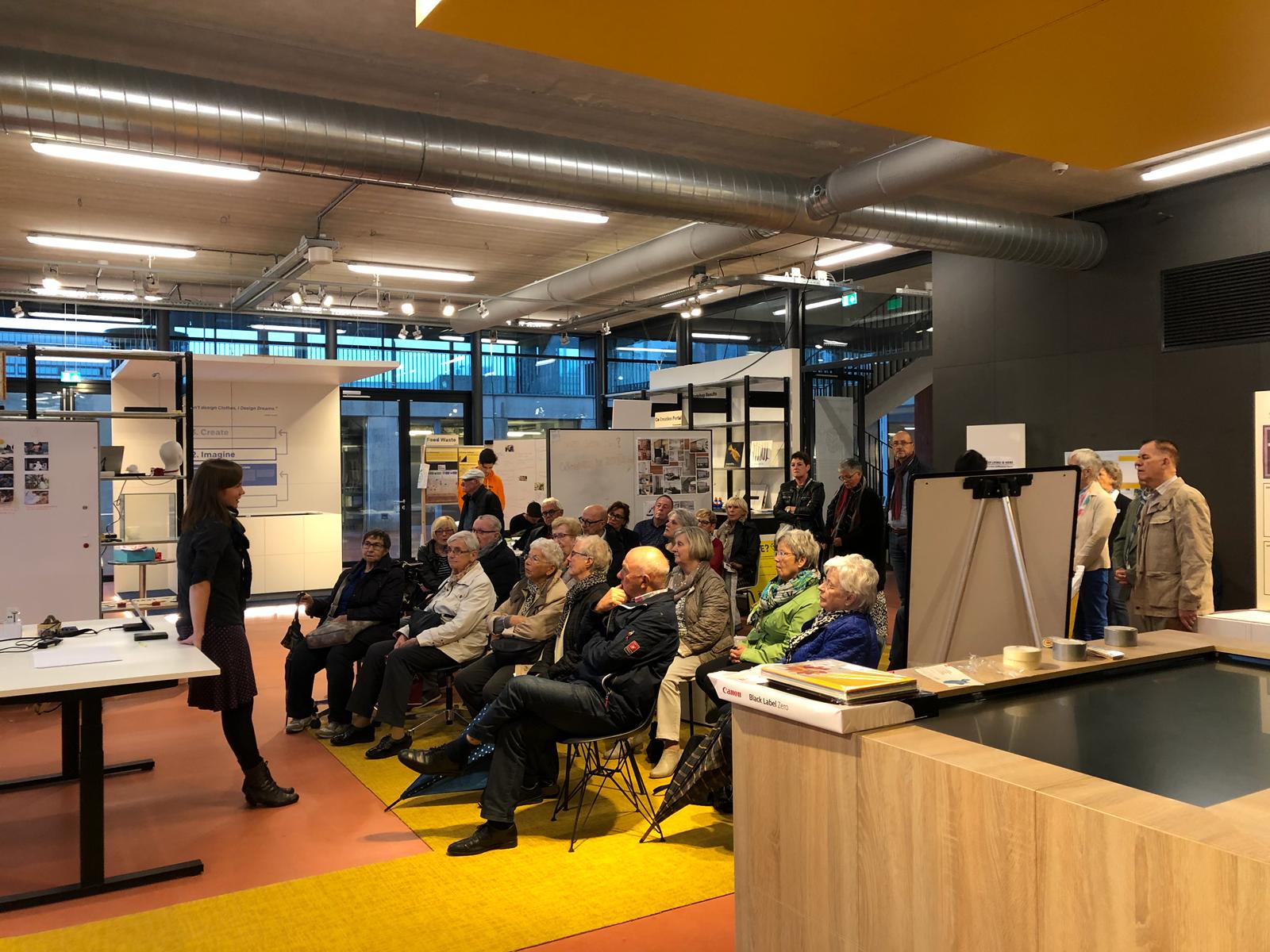
Through experiences such as doing an internship, joining the board of UNID magazine, and working part-time for the design research company Vilans, I learned several important things. Besides getting experience working in a professional setting instead of the university, I got the opportunity to do a lot of networking. I got to assist in hosting design events like the first Euregional Design Year-End Meeting, with attending design companies from all over the Maas-Reihn Euregion, and presenting my work 2 years in a row at the Dutch Design Week before Covid. I always enjoy meeting new people behind different design companies in the Netherlands and across the borders and hearing their stories was very inspiring.
At last my internship also taught me to identify macro-economic trends and to translate design to micro-economic processes. My growth here allows me to recognize trends in our society and translate them to human needs, I can design for.
Also during several of my own projects at the university I got the chance to work with multiple techniques in the field (e.g. creating value propositions and calculating revenue streams). Through projects as ‘analyzation market needs for Smart Goals’ I got insight into what work comes into play when one wants to turn their project into a startup.
This expertise area circles back to my vision on design as I find it important to pinpoint my users or markets needs and therefor highly value company involvement during my projects. Company involvement allows me not only to learn from experts but also have connection to users and stakeholders in the area I’m designing for.
Courses that contributed to my development:
- Design Innovation Methods
- Researching the Future Everyday
- Human in Technology: introduction course
Math, Data and Computing
In my work I see the strength of Math, Data & Computing as the ability to use data to support my arguments, identify patterns, and give meaning to the numbers and quotes collected. Getting lost in complexity and being able to make sense of it by using analytical thinking, resulting in informed decision making.
Throughout my study at ID I got to work on several projects collecting and analyzing different datasets. Examples of this are the quantitative data sets I collected during my research project for ‘Constructive Design research’ where my team and I looked at how city biking data would influence goal-setting behavior of daily cyclists. But also in projects for Vilans where I got to analyze user app requirements with statistical tools (e.g. Coosto).
However the data that makes my designer heart beat faster is oftentimes qualitative interview data. Talking directly with my target users, asking them about their personal experiences and opinions while trying to get to the bottom of it. Interpreting their answers and seeing how the insights gained through thematic analyses align with results from my literature research (e.g. about motivation in my project for chronic disease management).
Qualitative data is important to me as it helps me gain an understanding of the underlying reasons, opinions, and motivations of my target group. As described in my vision I realize that to truly help my target group with my design I need to make sure I’m tackling the core issue and qualitative research helps me to dive deeper into the problem. During my individual design (research) projects I often worked with long-lasting focus group sessions and user studies, which led to piles of large transcriptions covering the conversations. Also during my literature review for my M1.2 project I had to learn to navigate these large amounts of data and insights.
I noticed I quickly became more able to process these large amounts of data better, analyze them and notice what is most important to take with me in the next iteration. Through physical mapping but also excel files I learned what works for me with which data sets.
Courses that contributed to my development:
- Constructive Design Research
- User Experience Design
- Inleiding Modelleren
- Design < > Research
- Calculus

Professional Skills
Professional skills might be the most important expertise area of all. It forms my professional identity and determines my role in a group during a design process.
At the start of my bachelor’s at ID I was only 17 years old, my lack of confidence prohibited me from expressing myself with confidence during group meetings and pitches in front of clients and coaches. But by pushing myself out of my comfort zone as I grew up I developed myself, and stepped up. I grew more and more comfortable with expressing my ideas and work. And as I’ve started to share more, I experienced how much team members appreciated and valued my opinions and point of view. I expressed earlier how I see it as a strength that I can almost work as a “translator” between different stakeholders, and I take on this same mediating role within design teams. I like to host discussions and bounce off ideas with team members.
Because my head can get very chaotic when filled with ideas and plans I value organization. Especially within a group will always introduce digital planners and encourage documentation throughout the process, staying organized and planning ahead.
I also learned the importance of continuous reflecting throughout my process. Not just about the steps I’m taking in de development of my project but also on my own work ethic and boundaries. After burning out at the end of the first year of my Master’s and being forced to delay the continuation of my studies for the rest of the semester, I took a lot of time to reflect what went wrong and how such derailing can be avoided in the future. Especially Covid restrictions made the Master’s a very lonely period in my life lacking (mental) support and suddenly spending a lot of time in a single small room instead of being surrounded by inspiring work and people at uni. However I managed to work through it and actively went out of my way to form online support groups with fellow students as well as actively involve experts and users every step of the way in my design projects. I know I work best in groups, so even if I don’t get assigned one, I’ll surround myself with people to brainstorm with.
Lastly my development in the Creativity & Aesthetics area also comes back in my professional (presentation) skills. I continuously learned how to better visualize results and share professional graphics and documentation with my clients.
The Future
Throughout my master’s I have had many discussions with fellow students about what the role of an Industrial Designer is. During our time at the university we have all been educated in such a wide variety of skills (From creating aesthetic value to analyzing a business case study to coding a social robot). This might remind you of the popular saying “a jack of all trades is a master of none”, however contrary to the initial degrading meaning of this quote I believe this to be a great strength. I see the role of an Industrial Designer, as someone who has knowledge of different fields and who uses this knowledge to create value and communicate between experts and stakeholders. I see myself as a translator between the world of technology and the common user.
I believe the strength in our education did not lie in the practical knowledge of how to set up a data study, I believed it lied in creating a mindset and a work ethic. Already during my internship and side job as a research assistant I noticed how my proactive work ethic was appreciated and how supervisors were impressed by the natural leading role I would take over my fellow interns when planning out a project trajectory. Always being critical and asking my co-workers “why?” every step of the way. Little intangible things I took for granted at the TU/e, but only when stepping outside realized how valuable it is.
This makes it that although I did not specialize myself in Technology & Realization during my master, and know I am not the strongest candidate to hire for a programming job, I believe I am a great asset for any technology-driven team. I’ll be able to be actively involved in every conversation, let it be between programmers, clients, or users. Brainstorm with them and translates insights I gained from one group to the other. Always holding an overview over the bigger picture, asking the right questions, and offering the most accurate project directions.
I look forward to working in creative multidisciplinary teams where I can showcase the value of the implementation of the User & Society and Creativity & Aesthetics expertise areas. Improving communication and hopefully lead to some exciting ideas, that turn into concepts and even into something real. The type of company that I can see myself working for focusses on social design and healthcare, a place where I can be in contact with real people and explore user experiences. Through my experience working at Vilans as a research assistant during the development of a renewed dementia care model, I already have made connections in the area of elderly care which is nice since this is an area where I definitely see myself returning.
However I am open to look beyond my currently known world since I, as stated before, believe I have something unique to contribute that can be valuable in many different design teams.
But this is for the long term future, before the summer I will first continue to follow courses at this university to receive my Philosophy of Technology certificate and finally plan a very relaxing holiday.
 Kyara Fasen