
Pettow – 2th year Bachelor 2018
Aim: Gain more insights into how to help dementia patients reduce stress
Theme: Elderly care, dementia, loneliness
Client: Pleyade
It is proven that robotic stuffed animals help dementia patients to reduce their stress. But why and how? Together with my team I created a series of pillows with different animal features (warmth, breathing, etc) and put them to the test. Resulting in a final design of a pillow that can help people with dementia to reduce stress.
Video: https://youtu.be/nNKzf06MC5Y
This project is a qualitative research project about people with dementia, focussing on how to make them feel more comfortable living in a nursery home instead of their personal home where they used to live. Implementing warmth and a playable texture is proven to give a calming stimulus. Hence, our design is focussed on this.
Working together with Pleyade, a care home facility for elderly, gave us the opportunity to test prototypes and to come to conclusions why certain stimuli worked to calm its users down, while others did not.
Inspired by assistive robots like the already existing PARO, the seal for elderly with dementia, and other designs, we created Pettow. Pettow is a pet-pillow with some animal features to reduce the stress of the elderly. We looked at how we could extract the essence of these robots and keep it as simple as possible.
Features that proved themselves to be really effective in helping elderly with dementia at Pleyade to feel more relaxed are the warmth feature and playable texture. The breathing could be a good addition but this needs more research and attention before this can be stated clearly. The heartbeat should not be implemented in the design, because of the fact that it made the elderly only more scared and anxious. These main insights lead to our final Pettow design.
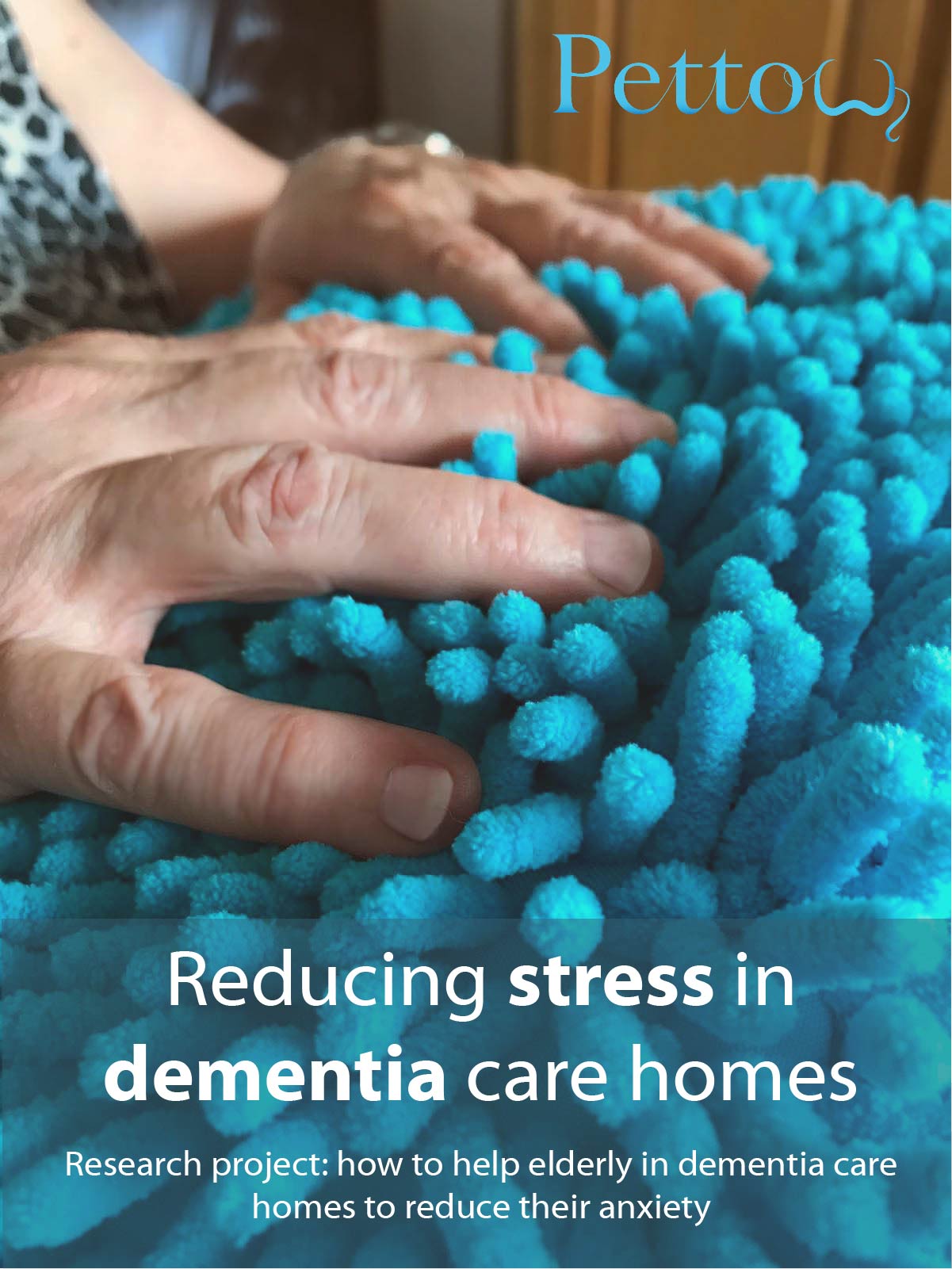
The final design is a curved pillow with a soft white fabric at the bottom and a thicker playable long haired texture on top. There are no vibrant colours used and the pillowcase should be washable. The warmth element is put over the entirety of the bottom of the pillow so it is nice on the lap or against the belly and the warmth is also more tangible at the bottom in comparison to when it would be just below the thicker fabric of the top. The whole pillow inflates and deflates simulating a calm breathing pattern. The pillow does have ears to fiddle with but there is no tail attached. This is removed for safety reasons. As for the target group, wanting to test with participants with stage two and three dementia but having also tested with a few participants in stage one, we could clearly see that for whom the pillow worked best. The people with dementia stage one were very much exploring the pillow rather than just stroking and experiencing like the participants in stage two and three did. So, Pettow is indeed best for those in stage two and three, confirming our expectation. The caregiver also agreed on this.
All in all, it can be concluded that the pet features need to be obvious and tangible yet organic and the textures should be playable.
 Kyara Fasen
Leave a comment